Showing posts with label Ajanta Caves. Show all posts

Sunday, 11 December 2011

Aurangabad - Part VIII - Aurangabad Caves

From the great Daultabad we headed towards the Aurangabad Caves. Enroute we passed Bibi Ka Makbara and went further ahead towards a hill, the next destination being Aurangabad Caves which were just 2.5 kms from Bibi Ka Makbara. It was 12.15 pm and the sun was radiating with all its power. Our driver said that we could finish the caves within half an hour which seemed a bit impossible to me.

Aurangabad Caves are 12 Buddhist Caves which are spread over the hills past the Bibi Ka Makbara into 3 different groups. These groupings are done as per the location of these caves. At the western side there are 5 different caves – Cave 1-5. To the eastern side caves 6-9 are located in the second group which is almost a kilometer apart from the first group. The third group – consisting of caves 10-12 – is at the close proximity of the second group, only 100 meters or so apart. The caves are datable from circa 2nd – 3rd century AD to 7th century AD.

Our car first came to the western side of the hills. This is the main entrance of the caves and you have to buy the tickets from here. So always start from this side.

We bought the tickets (5 Rs per head again) and entered into the complex. To our utter frustration, we saw a number of stairs which we needed to climb to reach the level where the caves resided. We knew how the climb was going to be under the sun – steep and arduous and so it was.

After much gasping and panting we reached the top and started visiting the caves. There was some repair work going on.

Cave 1 was an unfinished vihara. It is amongst the oldest of this series of the caves. This belonged to the 2nd-3rd century AD.

Cave 2 was also a vihara. There was shrine of Buddha at the rear.

Cave 3 was a chaitya hall which dated back to the Hinayana age, again built around 2nd-3rd century AD. This cave was in a state of so badly preserved that the whole stupa and the pillars were being reconstructed by concrete and cement.

Cave 4 was a very simple chaitya which was excavated around 4th century AD.

Cave 5 used to be a small temple but the whole front collapsed.

We visited these caves in quick succession, in one of the caves (Cave 1 or 2) there were great carvings and sculptures, some equally comparable to the great Ajanta & Ellora in regards to the skill with which they were carved.

We came back to the main entrance, got in the car and then headed towards the eastern side of the hills. After 5 mins we reached the parking and we were thankful that there were no stairs this time.

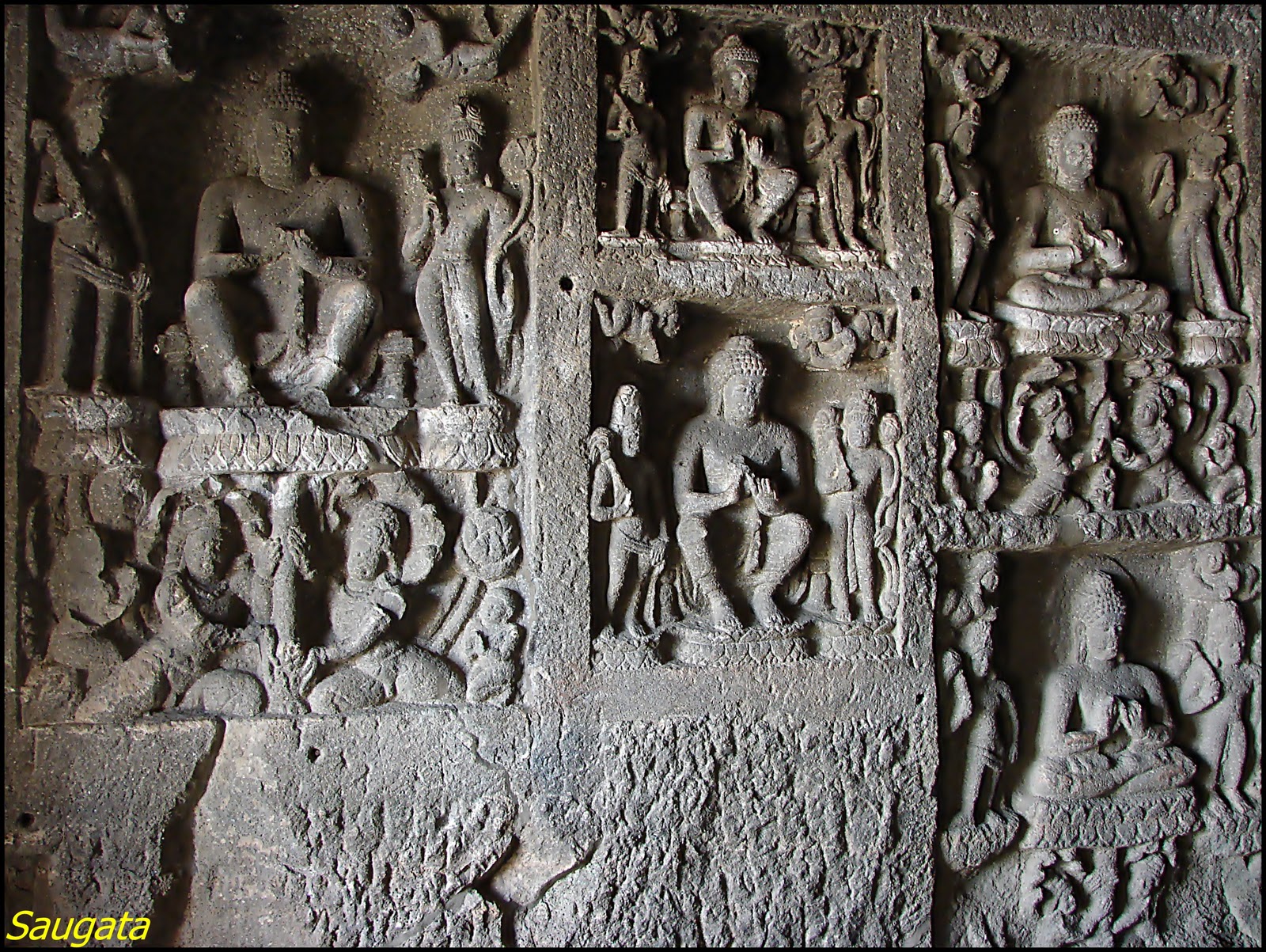
Cave 6 looked like it had the features of a vihara and a chaitya both which was unique. It had carvings of Buddha in a teaching gesture and with many other carvings like dwarfs, worshippers etc.

Cave 7 was the most important of all these caves and bore a lot of carvings of great elegance. It had famous carvings of the Boddhisattva Padmapani delivering from the 8 great fears of the Buddhas, Tara the start Goddess, avalokitesvara etc. One of the most famous sculptures was a group of six female musicians. As per ASI board at the entrance, some of the sculptures here are more elaborate than the same examples in Ajanta and Ellora. This statement itself justified the splendor and majesty of the carvings of this cave.

Cave 8 was an unfinished one, and it looked as if the excavation work just commenced.

Cave 9 is in ruins and nothing much is left to see here, other than a sitting Buddha statue.

The last group of caves can be reached by flight of stairs (not again!!). But Caves 10, 11 and 12 are perfectly plain and did not bear anything significance. Cave 10 is almost buried up while cave 11 and 12 were unfinished.

To our surprise, we completed the 12 caves within half an hour as predicted by our driver. Perhaps we did not do justice to these caves but to be very frank, we did not have much strength left within us to carry on.

We then proceeded towards Bibi Ka Makbara.

Snaps are here -


Tuesday, 22 November 2011

Aurangabad Part VI - Ajanta - The Caves

Cave 1

This is one of the important caves which contains a lot of paintings. There is a large hall and pillars around both sides. Many important and famous paintings and sculptures are here as below – the great Buddha Image, Goddess, Cherubic Dwarf, bodhisattva, four deers with a common head, the lovers, dark princess, dancing girl, princess reclining by a pillar, a maid in a sad mood, Persian embassy, the golden geese, pink elephant, bull fight etc. The most famous painting here is ‘Boddhisattva Padmapani (Lotus in hand) and Vajrapani’ which are considered to be one of finest paintings in the world of art.

Cave 2

This is next to Cave 2 and another important cave. This is quite similar to cave in architecture and also contains many fabulous paintings on the walls and the ceilings. The skill with which painters lay down on scaffoldings for long years, to paint these pictures, is reminiscent of the way Michelangelo suffered physical strain while painting the ceilings of the Sistine Chapel in the Vatican in Rome. The famous paintings here are – Thousand Buddhas, Votaries with Offerings, Women on Swing.

Cave 3

This is an incomplete vihara (monastery) and there is nothing of much significance.

Cave 4

This is also a vihara which consists of a hall and pillared verandah. This is the largest monastery of the Ajanta excavations. The cave was also painted which is visible from the remnants.

Cave 5

This is an unfinished Vihara.

Cave 6

This was the first important cave of the Mahayana phase. This is a double storeyed monastery. It also has some fabulous paintings such as – Bhikshu with Lotus, Miracle of Sravasti, Temptation of Mara the Evil One.

Cave 7

This is another monastery which contains sculptural marvels like – preaching Buddha, Miracle of Sravasti, seated Buddha under the protection of Nagamuchalinda, etc

Cave 8

This is an unfinished monastery located at the lowest level and perhaps earliest among the monasteries. Major portion of the frontage has been swept away by a landslide.
Cave 9

This is a Chaitya (prayer hall). There are two early paintings, which survive. Frieze of Animals and Herdsmen Naga Worshippers. The chaityagriha exhibits reproduction of wooden architectural styles

Cave 10

This is another Chaitya Hall. This also houses some famous paintings – King with His Retinue, Shad-danta Jataka, Shyama Jataka, Elephants in Jungle, Pricess and Tusk, Buddha and the One-eyed Monk, etc.

Cave 11

This is another monastery which has an unfinished stupa. Few paintings that available here depicts Bodhisattvas, figures of Buddha, etc. This cave is also interesting as it shows the transition from Hinayana to Mahayana.

Cave 12

This is a monastery and front wall of which is completely collapsed.

Cave 13

This is a small monastery.

Cave 14

This unfinished monastery was excavated above Cave 13 at a higher level.

Cave 15

This is a monastery with eight cells, antechamber and pillared verandah. The sculptural depictions include Buddha in various postures, seated Buddha etc. The traces of paintings indicate that it was originally painted.

Cave 16

One of the finest paintings of the art world is housed here – the Dying Princess. The other notable paintings here are Buddha with a Begging Bowl, Prince Siddharth stretching the bow, the Sutasama Jataka etc. There is a giant statue of Buddha in a teching gesture.

Cave 17

This monastery is another example of the finest paintings – Apsaras and the flying spirits, Indra and the Apsaras, Royal Procession, Shad-danta Jataka, Prince Simhala, The Buddha Returns.

Cave 18

This consists of a rectangular excavation leading into another cell. This houses one of the exquisite paintings – Princess looking in the mirror.

Cave 19

This is a Chaitya hall. The stupa is carved with a standing image of Buddha.

Cave 20

This is a pillarless monastery. Buddha in preaching attitude is housed in the sanctum. The sculpture of seven Buddhas accompanied by attendants is another important sculptural panel in this cave.

Cave 21

One of the most fabulous of Ajanta, from the perspective of the carvings. This is basically a chaitya hall which houses a 24 ft long statue of dead Buddha on the left wall – This is called as ‘Buddha in Parinirvana’. There are carvings of disciples of Buddha moaning and heavenly deities welcoming Buddha in heaven. The peacefulness which was carved on Buddha’s face is truly astonishing. As per my opinion, this is the best of Ajanta’s sculptures, at least if expressions are concerned.

Cave 22

The sculptural depiction of Buddha in different forms, painted figures of Manushi-Buddhas with Maitreya can be noticed here. This is basically a monastery.

Cave 23

This is an unfinished monastery.

Cave 24

This is another incomplete monastery.

Cave 25

This is a monastery but the hall is devoid of any shrine.

Cave 26

This is similar chaityagriha like cave 19, but much bigger than 19. The horseshoe arch is quite breathtaking. There are various sculptures, undoubtedly carved with rare talent and skill.

Cave 27

The monastery consists of a hall with four cells, antechamber and sanctum sanctorum. Buddha in teaching attitude is housed inside the sanctum.

Cave 28

This is an unfinished monastery.

Cave 29

This is an unfinished chaitya griha.

Under the scorching heat, we were quite exhausted by now. We did take a lot of rest in between traversing through the hills. We required a lot of water intake without which it is impossible to walk. We now started towards the exit. We crossed a small bridge on the river Waghora. The path through jungle was quite pleasant with cool shadows provided by the trees. A lot of fully bloomed flowers were there to enjoy, if one can after the industrious walk. We came to outer entrance and went into the MTDC restaurant just to find out that the place is fully occupied. We were quite hungry but other than this place, there were not eateries around. Upset, we came back to queue for the bus. Buying the tickets, we came to the base and hurried to the first eatery we found and had a sumptuous meal. It was already 5 pm, but we could see hoards of people still proceeding towards the top. I came to know from a local that these are the people who would stay at the MTDC resort and would start their journey in the early morning. It seemed a great idea to me. If there is a next time, I will definitely do this.

We came back to the hotel around 7.45 pm, had a bath and then an early dinner and went to bed straightaway after the hectic but deserved effort.

Ajanta made us both exuberant and poignant. We – and thousands others, Indians, Japanese, Koreans, English, Americans, French – all were spellbound, hypnotized and mesmerized. The paintings had so much expression and emotions, the sculptures were so much precise to the minutest of detail that we were completely swept away by their splendid grandeur.

We have now with us an experience of a lifetime.

Paintings -


Carvings -


Sources:
For this post, I acknowledge -

http://en.wikipedia.org/wiki/Ajanta_Caves
http://www.aurangabaad.com/
http://ajantacaves.com/
http://asi.nic.in/