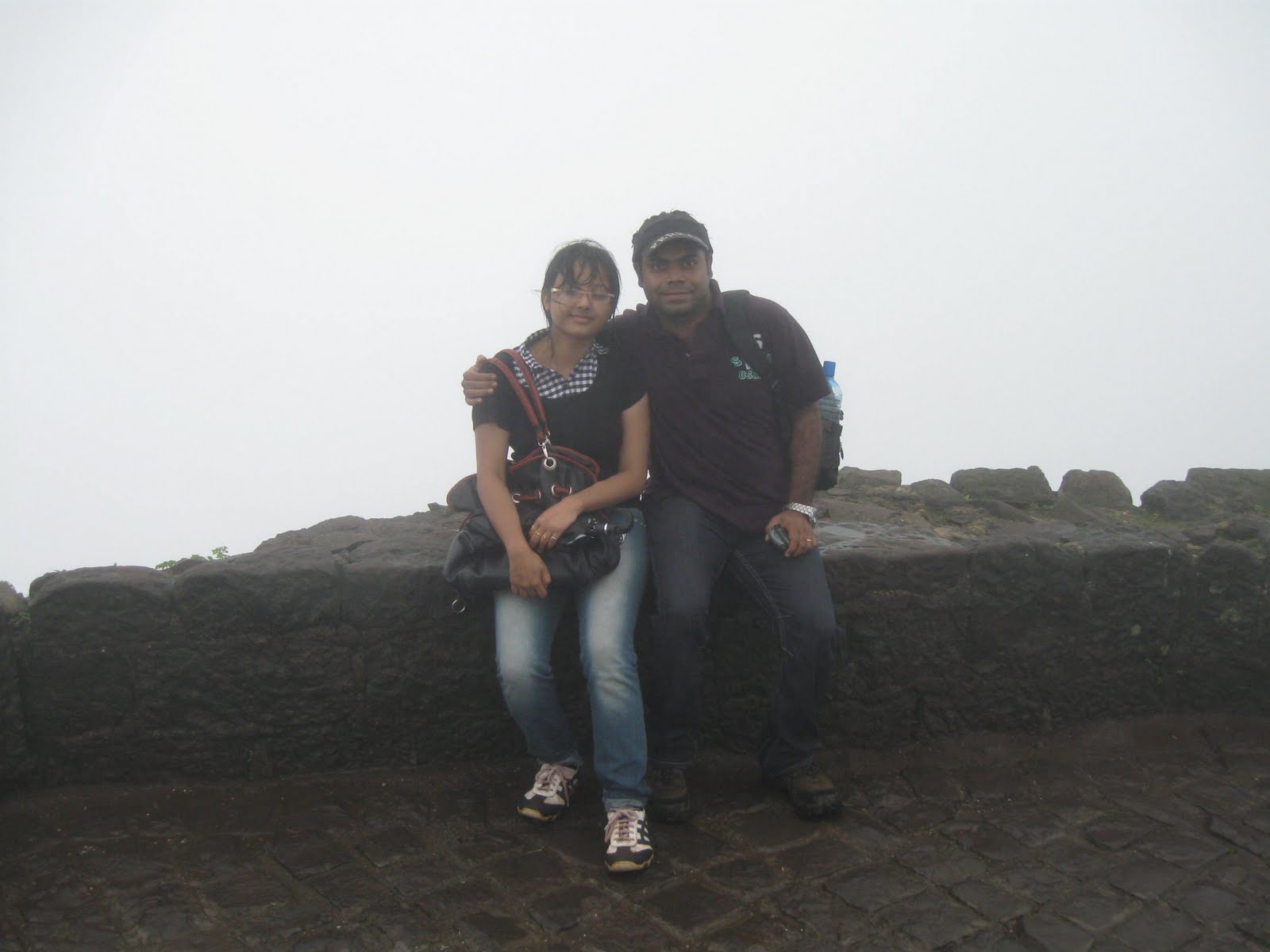
Wednesday, 14 September 2011

Sinhagad - The Lion Fort


Hills Covered in Mist
 Sinhagad Fort is one of the most popular weekend gateways for the Punekars in the monsoon. So we were no exception and this place was a must for us. Besides its charming attraction it has a proven historical background of its own.


Sinhgad Fort was previously named as Kondana Fort. Chhatrapati Shivaji's right hand man, Tanaji Malusare, captured this fort from the Mughal Army during the famous battle of Sinhagad in March 1670. In the course of the fight, Tanaji lost his life and Shivaji expressed his grief through the words " we have won the fort but lost the lion" and that was how this fort picked up its current name - Sinhagad which literally means The Lion Fort.


How to go:


From Kharadi, one needs to go towards Hadapsar. Once the Hadapsar flyover comes, take the flyover to the right and go towards Swargate. Pass by the Swargate junction and go straight. You will come across a T-junction from where you need to take a left. Immediately after taking this left, there is a 'Mahalaxmi Temple' on the left and here you need to take a right turn to take the Sinhagad Road. Once on this road, you have to drive straight for around 25 Kms to reach the Sinhagad Fort base. You can also park here and set on a trek if you love it. Otherwise you can drive straight to the top.


Here is the map.


Sinhagad Fort can be enjoyed the most during the monsoons, due its height and location.


We started off on a Sunday morning around 7 am. We passed the Khadakwasala lake. After Khadakwasala, there is a junction from where you need to drive straight for Sinhagad. If you are heading off to Panshet or Varasgaon, from this junction you should take the right turn. The first photo pf this post was taken while we were passing this Lake.


Winding Up Road


Road through the Lush
 After reaching the base, one can see the glimpse of commercialization - there are lots of shared jeeps which can take you to the top. At the base, you have to pay a tax of 50/- to enter the forest area. The road was a kind of eerie and steep. Many a times I had to drive on first gear due to the sharp hairpin bends and steepness of the road. But the scenic beauty was superb - the thick forest creates a shadowy atmosphere.


At one point, there is a small junction where the straight goes to the top and left - I don't know. The landmark here is a tea stall at this junction which will be on your right when you are ascending. My recommendation to everyone is to stop here once. The view from this point is simply breathtaking. There were waterfalls running down through the hills like a silver lining at a distance, the backwaters of Khadakwasala Lake were looking like a plate of huge glass. The greenery all through the road was thick and lush.


Green and white :)


Green and white - what a combo


A small cascade with full zoom with my baby camera


Greenery all around


The Road through which we came


Backwaters of Khadakwasala


Khadakwasala Backwaters - another angle. Mist is taking over the control


Once we reached the Sinhagd parking, the fort was under the mist and a real heavy wind was passing. It is always like this at Sinhagad in monsoons. This is my second visit to Sinhagad - I experienced the same weather when I was here for the firt time. Well, this is the beauty of it.


Behind the mist, Sinhagad was looking like a humongous structure standing with all its pride acquired over the years.


Sinhagad - hidden behind the mist, but can you feel the wind


The base - Structure of Sinhagad is behind


Parking at the top - always full
 The top was very much commercialized with loads of cars parked covering every inch of the parking. Additionally there were innumberable number of tea-stalls, shops for Kanda Bhaji, Bhakri, Vada Pav, Roasted corn (makai) etc. We also had a cup of hot tea and a plate of mouth-watering kanda bhaji. One shouldn't miss these while at Sinhagad.


From this point, you have to climb through the stairs. During the monsoons the stairs become real slippery so be careful. There are not much remnants of the fort, but some of the entrances and bastions are still standing.
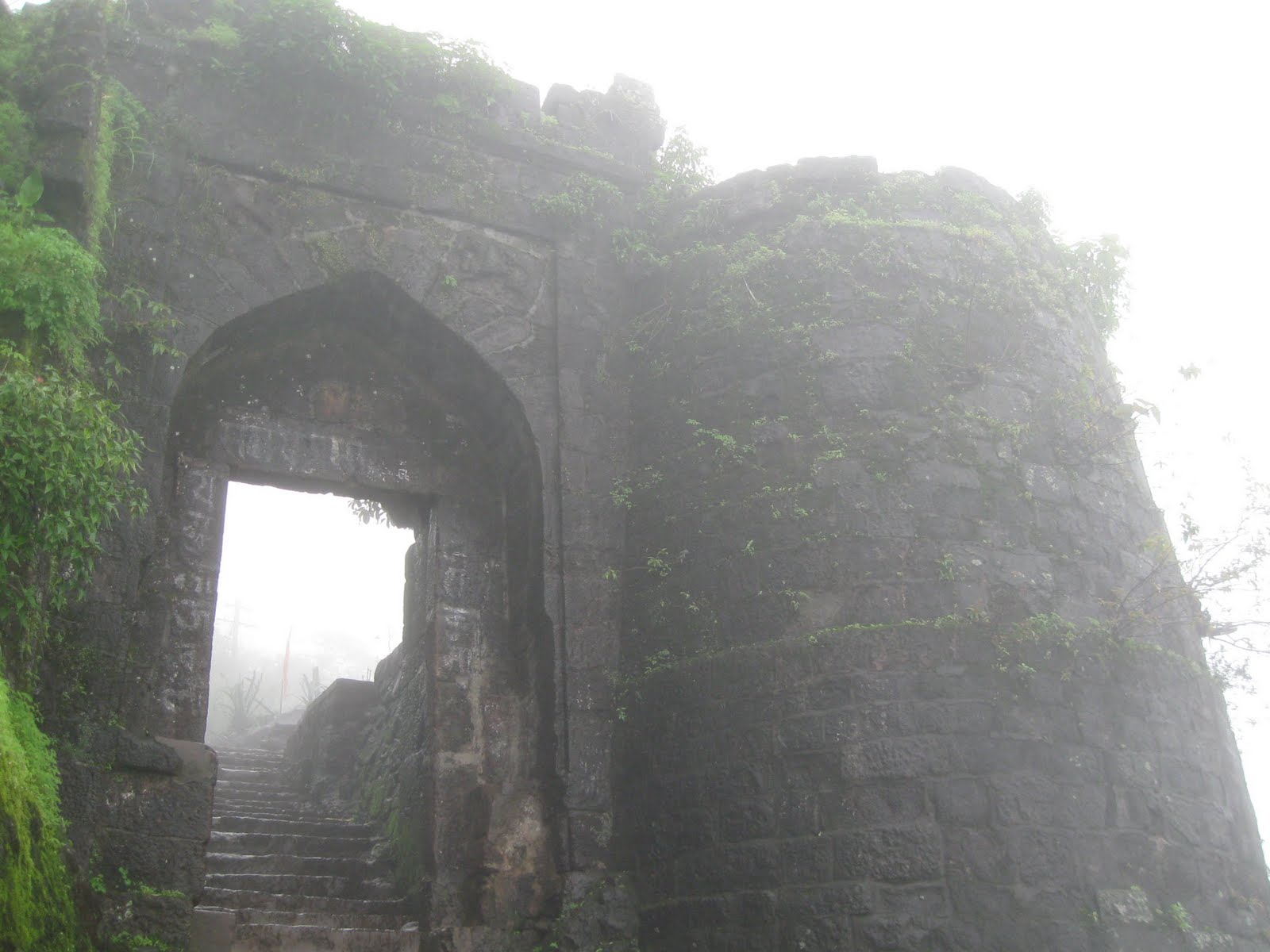


The main entrance


Slippery Stairs


In front of the main entrance


Second Entrance - bakdrop is the mist in full swing

Fortification


The owner of the fort :)


After these doors, a small road to the right will lead you to a dilapidated structure of a room/building.


The small diversion on the right, with the fortification - covered under the mist


Remnant of a Bastion??

The deserted structure - still standing tall


We came to the main road (I forgot to say - most the roads are constructed by the government and are of concrete) and passed by too many number of small shops selling bhaji, pitle bhakri, lassi etc. You may feel like you are walking through a park - there is even a Doordarshan Tower inside the fort!!!Well, don't mind and get going will be my advise. Enjoy whatever you can.


Going straight you will find the tomb of Tanaji Malusare and a small detour from here will lead you to the old 'Kondaneshwar Temple'. This temple was responsbile for its earlier name.


Tanaji's Tomb


Kondanewshar Temple


Coming down from the temple you will pass by a pond which was used to store the drinking water of the fort. We went to the edge of the fort from a small diversion but due to the mist and the wind nothing much was visible.


Age Old Pond
Some remnant - gets covered with green in monsoon


Edge of the fortification - steep cliff on the right


Keeping on the main road and going straight will direct you to the end of the Fort. This part is too much windy and we found really difficult to walk or stand. The fortification at this part is still standing.


Fortification towards the end


The same fortification - from another angle


Fortification - from the other side


The windiest part of the fort


Coming back with a U turn but with a different route we found some more fortfications and an old Hanuman Temple. That justified the presence of some big monkeys all around Sinhagad.


Remnant


Remnants


Hanuman Idol
The path - covered with Makai Plants at both sides


Trying to explore the Makai Plants


Most of the top was covered by the Corn (Makai) Plants which served two purposes - it filled the place with lush green ambience as well as it served as a means of living for the locals who sell the roasted corn all around the fort in different shops.


Besides the entrance, there is a small row of caves - these were used by the sentries.


Rooms for the sentries


We spent almost 3 hours at the fort and then decided to come back. The whole place was covered with mist and it was raining. We were drenched but we had great spirits. So did a lot of ensthusiastic ones.


Coming down from the fort with that winding road is an expereince. Every now and then I found there was some vehicle coming from the opposite direction. The narrow road and the steep cliffs at one side made it a real adventure for me to drive.


We stopped at quite a few places for photography. The following are some of the views.


We made another stop at Khadakwasala Lake. It was almost 1 Pm then and the places was thronged by crowd - people were enjoying to the fullest.


The Road through Sinhagad - goes straight past the Khadakwasala Lake


The 'Jolly Good' Fellas
We drove down and came back to our 'home-sweet-home' where we had our lunch.

Wednesday, 7 September 2011

Kanifnath Temple through Bopdev Ghat

I may be wrong but I sincerely have started believing that the every hillock in Maharashtra has something to offer on its top to amaze people like us. I have written about the Bhuleshwar Temple, but Kanifnath Temple is yet another example of this - a drive through the hilly roads of Bopdev Ghat, a serene location and great view of the valley. In addition to that, if you are a devotee there is a uniqueness in this temple which I think you mustn't miss. 

How to go: 

I stay in Kharadi so all routes starts from here. From Kharadi you need to go towards Swargate through NH9. One the Big Bazaar and the Fame multiplex appears on the left, you have to take the immediate second left (the Prince of Wales drive) of it, i.e take the left after the one next to Big Bazaar. Go staright for few kms, once you reach at a junction, you have to take a left towards Kondhwa road. Going starting from this junction will take to the way to Katraj Park, so better check with the local guys if you are confused. Through Kondhwa Road, again go straight - there is no need to turn at any junction. Ask the locals for Bopdev Ghat if you think if you can do good with a little help for direction. You should come to a junction where you can see the hills with one road going straight through the hills and there is another going in the left. At this junction there is big restaurant on your left ( I can not recollect the name and I could not take a snap either because it was heavily raining). But anyway you need to go straight. Once the ghat section is over, after going for a few more kms, you can see a big board for Kanifnath on your left. This is a short drive (around 35 Kms) but it took us around 1.5 hours due to rains and also we were not sure about the direction so we had to stop and ask the locals.

Here is the road map:

When you see the board on your left for the ‘Kanifnath Gad’ , the narrow and bad roads start here. The first section of the road is narrow and full of potholes but driveable while the last 500 meters are steep and was not fully tarred when we visited. Many people usually park before this road starts and cover the rest of the distance by foot. As it was raining to make it even worse, a couple of times I was screeching the tyres .

The first sight of the temple which also shows a glipse of the narrow road:

and a glimpse of the bad road....


There is a parking space above so there was no difficulty for us in parking. But when fully crowded during Shivaratri, it may not be the same.

There are stairs which lead straight to the temple. You have to leave your shoes before you enter the temple at your own risk, alternatively there is a shop which can keep it for you. And the shop also sells sweets to offer to the God.


The temple seemed to be relatively new, though there is not much to see at the top. It offers some great view though.


The uniqueness of the temple which I was referring to earlier is that only men can enter into the main shrine and they have to remove their shirts before entering!! If this is not enough, the entry to the shrine is not a door, it’s a hole!! You have to lie down and then crawl like a snake!!

Obviously I am no devotee to try that one. Even if I were one, I wouldn’t have tried the same.

When we were coming down the stairs we saw there are some sculptures of Lord Hanuman.


We came down and found that there was one smaller temple at the opposite side, facing the main temple.
Just before you enter into the parking there is a big gate marking the entrance. This place is like small flat plateau from where the views were really good watch.


When I carefully looked on the road through which we came (the last 500 meters as referred earlier), there are some sculptures too (at the centre of the below snap). But this one does not do justice with the steepness of the road though.


We came down and headed to Saswad towards our next stop – the Balaji Temple at Narayanpur. Ironically the weather cleared after 15-20 mins!

The road through Bopdev Ghat - not many snaps because of the rains:


Balaji Temple in Narayanpur - Replica of the Tirupati Temple

The Balaji Temple near Saswad is said to be an exact clone of the ‘Tirupati Balaji Temple’ in Tirupati – but this is a miniature version of the original.

We went to this temple after we visited the Kanifnath Temple, but I will provide the direction from Pune for ease.

How to go: From Pune, you have to take the NH9 (Pune – Solapur Highway) and go towards Solapur. Then you have to take a right turn under the flyover, besides the Hadapsar bus stand. So keep your vehicles to the right side of the lane and do not go to the flyover. When you take the right, you have to go on to this road for around 40 Kms – this road goes through the Dive Ghat (a small hill section) and then straight to Saswad. Once you reach Saswad, you will see a Shivaji Statue on your right and a bus terminus (the Saswad bus stand). After this, keep going straight for 150 meters or so when you will come to a junction. There is a board pointing towards right depicting Narayanpur. You have to take this right and drive straight. This road will lead you straight to the Balaji Temple after 15 Kms. Enroute there is a small road which can you can see going straight towards the hills on the left. This road goes towards the famous Purandar Fort. More about this fort in separate posts.

Here is the map.

Inside the Balaji Temple, photography is prohibited. So there is no snap from inside, but if you do not enter the temple you can take snaps from outside circling the temple.

There is a large parking available outside the temple and from here you have to walk on. There are many parking attendants so parking is not going to be a problem. You can leave your shoes in your car or there is a shop to keep your shoes for free. Just besides this one, a canteen is there where you can have food and water.

For me the good part was they were giving away some ‘Prasadam’ (Sweets) to all the visitors. And the queue was long.

Here are the snaps of the temple from the outside. The first one is the entrance which itself looks like a small temple.


Though the temple itself did not give us the opportunity to take many snaps, the road towards the Temple were so breathtaking that we had to stop at many locations to engage ourselves in photography. So there are more snaps of the scenic beauty than the temple itself  The greenery actually started to show its true self after we drove for 4-5 Kms from the right turn at Saswad.

This road was a bit narrow at times but there are less potholes so you can drive easily.  But the nature is so beautiful that it will definitely make you stop many times to soak in the nature to the fullest.

No more babbling from me, here are the snaps.


Some snaps of Dive Ghat now. The not-so-full pond in the second snap is called as ‘Mastani Lake’. It is said that Bajirao Mastani used to come here to bath with the companions.