Our conquest has reached the last day but still had a long way to go. We already booked bus ticket towards Pune at 4pm – this was the popular AC Shivneri bus which run regularly between the Pune-Aurangabad route and this is MSRTC’s one of the finest buses. Mr Ashok arranged the ticket for us. As we did not have a full day, we started straight to Daulatabad Fort at 8.30 am and reached the main entrance of the fort by 9 am – fortunately we did not have any flat tyre today. 3rd time lucky!
Daultabad was built as city by the Yadavas, by Raja Bhillama in 1187 AD and it was known as ‘Devgiri’ at that time which literally means ‘The Hills of the Gods’. It grew to be a big city and remained as a Yadava stronghold for over a century until in 1294 Alauddin Khilji captured the fort. The Yadavas did not pay the tribute they were asked for and Malik Kafur - in 1307 and 1310 – occupied the fort. In 1318 the last Yadava King Harpal was flayed alive.
Devagiri day by day became an important base for the operations of the Delhi Sultanate's conquering expeditions southwards. In 1327 it attained a brief period of its biggest glory, when Muhammed Bin Tughalak, ordered his capital to be relocated from Delhi to this southern city. The Devgiri city was now renamed as Daulatabad. The entire population – men, women and children, rich and poor alike – of Delhi were ordered to march in a mass and move to the new capital. Even the sick and dying ones were not exempted from this long arduous journey, that involved a terrible toll in human misery and thousands of Delhi citizens perished on the way. And it was all in vain. The Sultan regretted his decision and repeating his act of madness ordered the whole crowd of migrants to move back to the abandoned capital, Delhi.
During the Sultan’s absence from Delhi the Muslim governors of the Deccan revolted; and Daulatabad itself fell into the hands of Zafar Khan, the governor of Gulbarga. It remained in the hands of the Bahmanis till 1526, when it was taken by the Nizam Shahis. It was captured by the Mughal emperor Akbar, but in 1595 it again surrendered to Ahmad Nizam Shah of Ahmednagar, on the fall of whose dynasty in 1607 it passed into the hands of the usurper, the Nizam Shahi minister Malik Amber, originally an Abyssinian slave, who was the founder of Kharki (the present Aurangabad).
His successors held it until they were overthrown by Shah Jahan, the Mughal emperor, in 1633; after which it remained in the possession of the Delhi emperors until, after the death of Aurangzeb, it fell to the first Nizam of Hyderabad. Its glory, however, had already decayed owing to the removal of the seat of government by the emperors to Aurangabad.
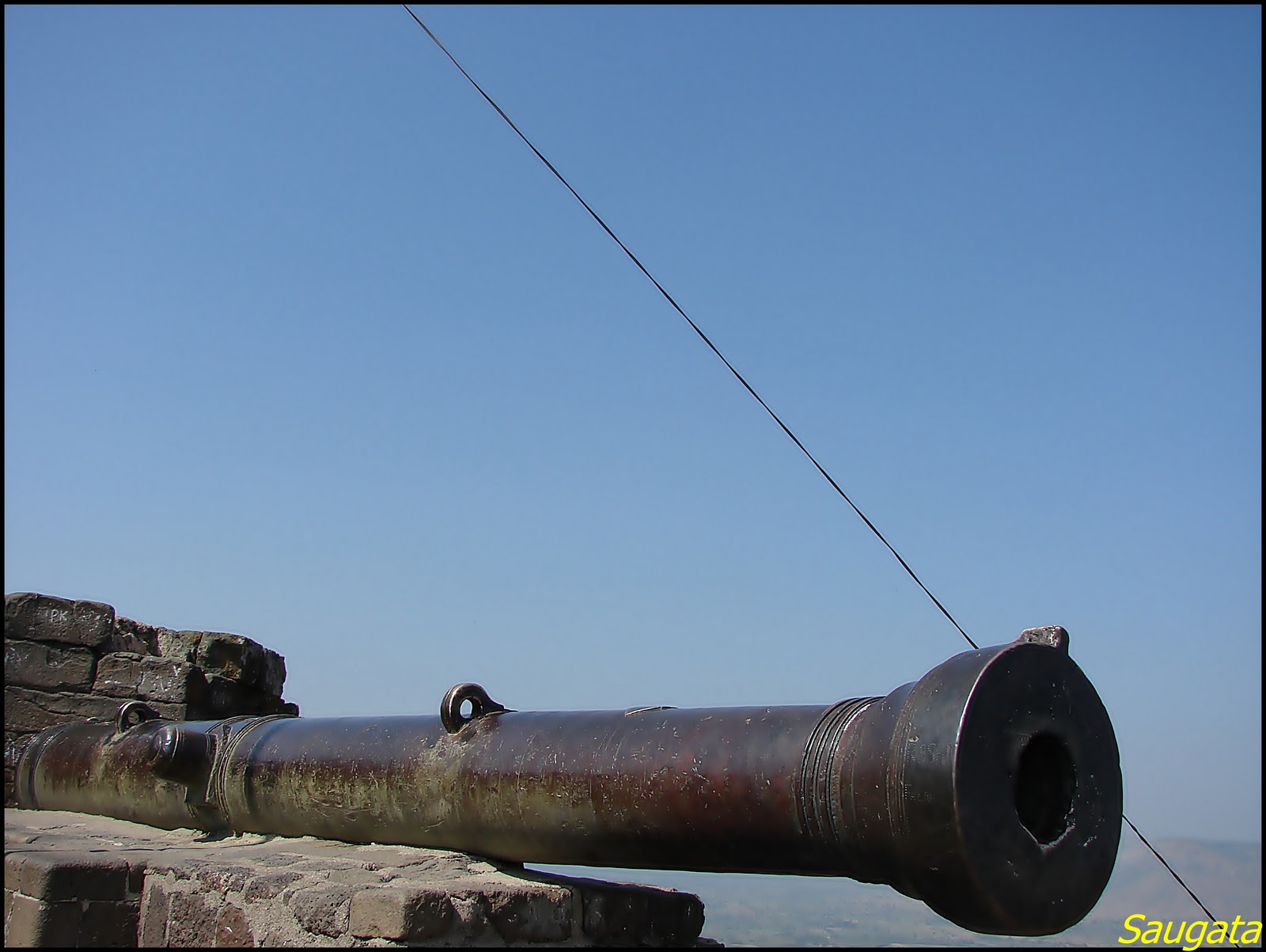
However Daulatabad grew to become a great city, rivalling Delhi in size and importance. The province to which it belonged broke away from the rule of Delhi and hence the fort was strengthened with more layers of fortifications and some huge cannons were strategically placed all around the fort.
This is arguably amongst the best constructed and survived forts all over the world but ironically this fort never in its lifetime witnessed a battle. Only once was the power transferred on this fort, and that too was by treachery and betrayal!
We were recalling these facts while we were on the way. Once we reached the fort, it was quite easy to see why the fort was considered to be impregnable. The huge fortifications and bastions were still intact. The gigantic structure of the fort is visible from quite a distance and the topmost structure was situated at such a location that it seemed to be invincible.
 |
| Main Entrance of Daultabad, the topmost structure is visible |
 |
| Courtyard before entering through the first gate |
We bought the entry tickets (5/- per head) and entered through the main gate. The gate was humongous in size – the wooden doors were still intact, studded with ferocious spikes – these spikes prevented the use of elephants to force the gate.
 |
| First Entrance |
We came across a small courtyard , upon which the second entrance stands. This is another huge gate with its surviving wooden gate. The courtyard is mounted with cannons of various shapes and sizes. One of the cannons was shaped like either a dragon or some other fearful animal!!
 |
| Courtyard - see the canons at both sides |
 |
| Carving on the wall of a courtyard |
 |
| The 'Jumbo' Cannon |
 |
| The Dragon Cannon |
Passing through this gate, the first structure we found is a lofty conical tower. This used to serve as a watch tower. At the upper end of the tower there is a small balcony with three arches.
 |
| Watch Tower from left |
 |
| Watch Tower from front below |
Besides this tower and after a small courtyard , another entrance was present on the left. As soon as we entered through this gate, we came across a really really high tower with red walls at a small distance. This is said to be around 65 meters in height and named as ‘Chand Minar’ (the tower which touches the moon). This is only second in height after the Qutub Minar in Delhi. The staircase to go us was now blocked for the public. There was an ancient Jain Temple on the right of this path, before the Chand Minar.
 |
| Chand Minar - the first encounter |
 |
| Jain Temple |
Just on our left there was another structure which was led to by a series of stairs. This was called as the Hathi Hauz and this was designed to be a swimming pool where the trainees can learn swimming.
 |
| Hathi Hauz |
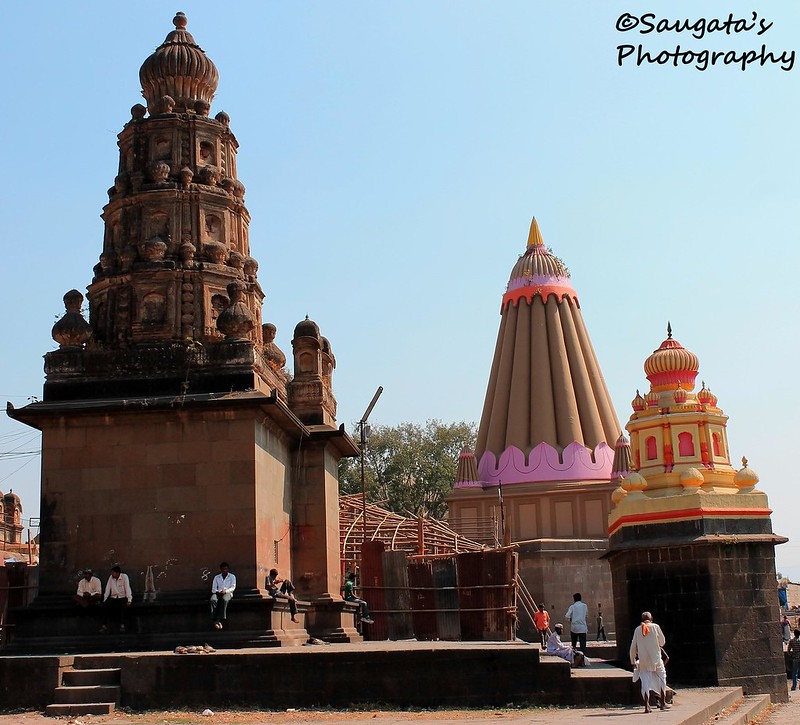
Just a bit ahead of the Hathi Hauz, we entered into a vast open courtyard beyond which amidst the cluster of carved pillars there was a temple – a temple of Bharat Mata, a Goddess personifying the modern Indian Nation. The broken pillars were a proof of marvellous carvings.
 |
| Entrance of Bharat Mata Temple |
 |
| Temple courtyard - topmost building at the backdrop |
 |
| Cluster of Pillars - Chand Minar rising with pride |
 |
| Temple Architecture |
 |
| The Idol with the little priest |
 |
| Carvings |
We came out of the temple through another exit which led the way to just in fron of the beautiful Chand Minar. Passing by the Minar, there were ruins of another temple. This was called the Hemadpanti temple. This was later used as a mosque.
 |
| Pillars enriched with exquisite carvings |
Going ahead there were a series of stairs and we came across another inner wall (third) and one more entrance – which was called as Kalakot. Going through these stairs, we came across a courtyard where there are 3 different structures – a citadel straight ahead, a ruined house on the right and another palatial structure on the left.
Beyond these constructions there is a moat which is 40 ft deep and a drawbridge was there, crossing this moat marks the beginning the original and the central citadel.
 |
| Drawbridge on the moat |
 |
| The 40 feet deep moat |
 |
| The moat from the top of the drawbridge |
There is one narrow entrance which we encountered just crossing the moat. This entrance was too dark and and narrow that it really would take a lot of guts to enter and proceed, even in the daytime. We were told that this entrance was the last defence of the fort and was called as the ‘Andheri’ or the ‘Dark Zig Zag Passage’ – this is an underground passage, nearly 50 meters long. The entrance seemed like a cave. While we entered in this passage in broad daylight, we realized what darkness really meant. In addition to the pitch darkness, there were several deceptive devices used in this passage to mislead the enemy. Small openings for light and air misled the enemy to fall into the moat. If one stood bewildered, stones were pelted from above.
 |
| Entrance of Andheri - too dark to venture |
There began a series of stairs , a steep and arduous climb – we came to know there were around 750 stairs to reach the top. We started climbing without knowing this actually. We might not have done this if we’d known that.
 |
| Climb continues |
We climbed and rested. We rested and climbed. We climbed till a place was reached which had a Ganesha Temple. There we sat under the shadow and consumed a lot of water.
 |
| People taking rest after the arduous climb |
 |
| Ganesha Temple - a much needed halt |
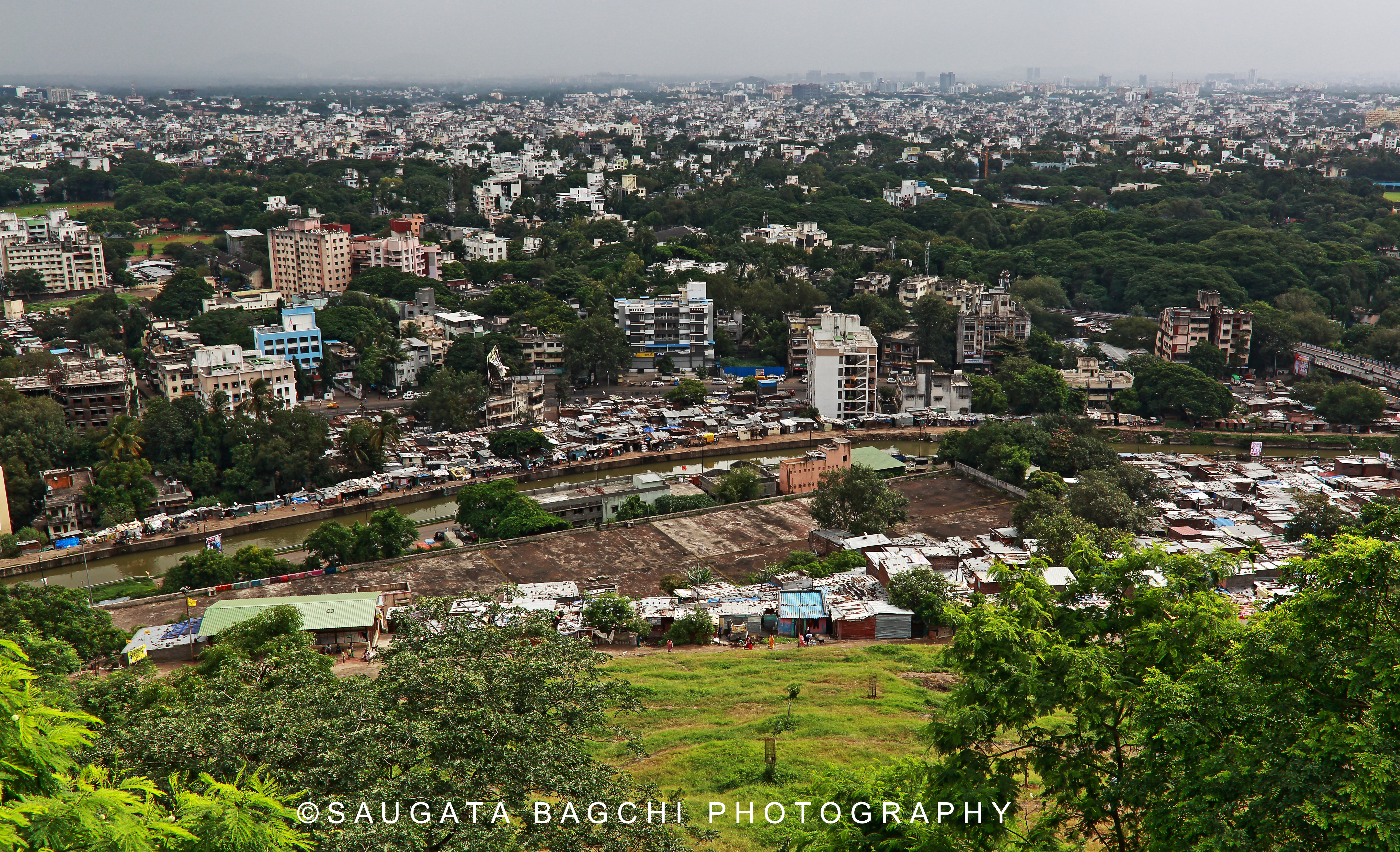
From this temple there were also a number of stairs to reach the top, but not many. From the top the whole city was panoramically viewable and though it was a hot sunny day, it was breezing at the top which was very comforting. Not only the city, but also the whole boundary fortifications were visible. We were amazed to see the whole area which fell inside the fort premises.
 |
| A view from on the way to the top |
 |
| Fortification walls of the fort from the top |
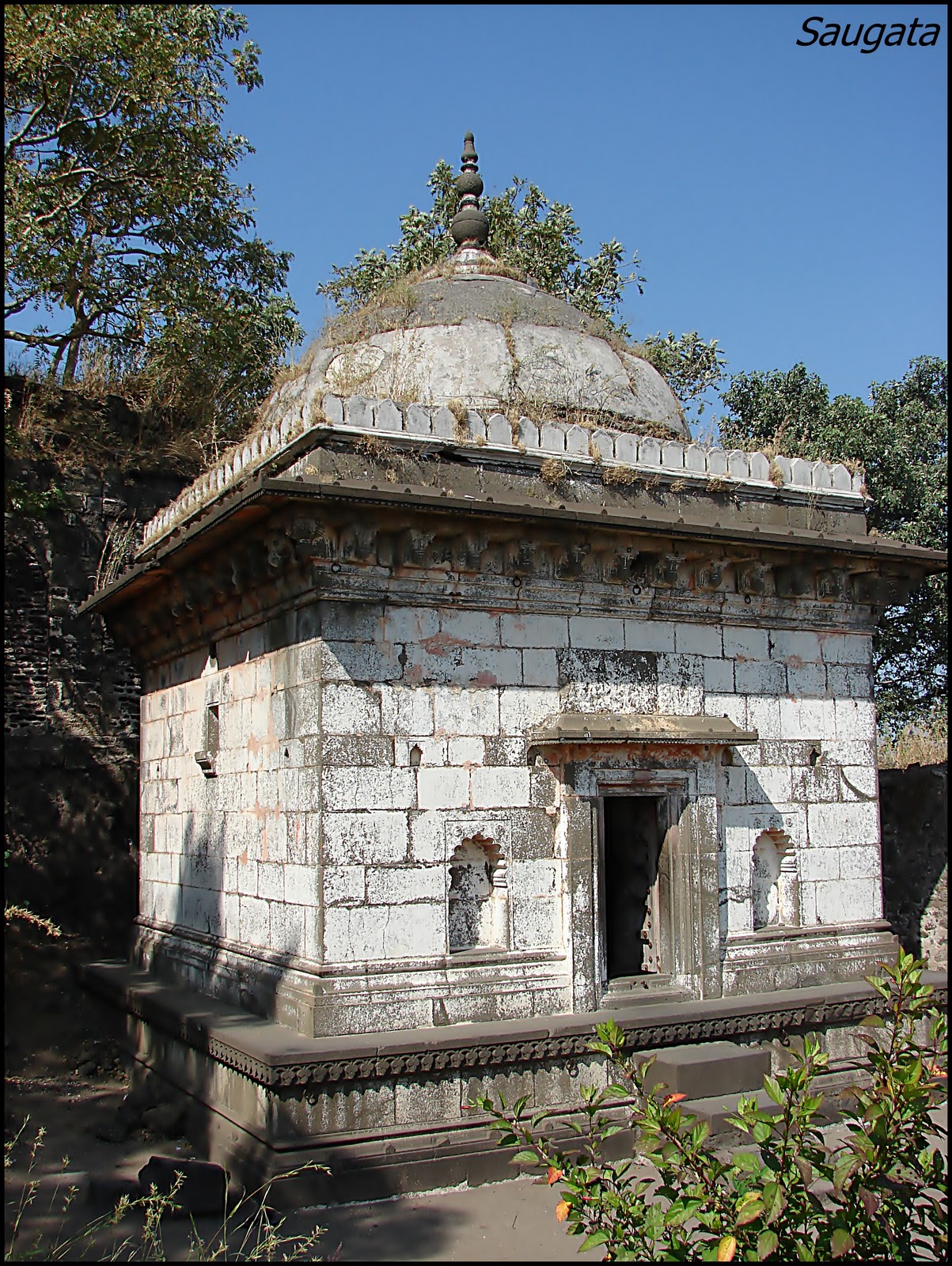
At the top there was a building called Baradari which was completely surviving through the ages. This was built during the times of Shah Jahan, the mughal emperor, This structure had twelve arches with many windows. It used to be a relaxing place for the kings from where they could enjoy the serenity at the top with cool wind and a panoramic view of the city.
 |
| Baradari building at the top |
We sat here for half an hour to gain some of the lost energy. I went further up – there was a dilapidated building which had two more cannons at the top – the durga cannon and the kalapahad cannon. It was really surprising to think how these heavy cannons were carried up at the top. All the cannons were really strategically placed facing all the important directions of the old days.
 |
| The Kala Pahad Cannon |
 |
| Durga Cannon |
As there was nothing else to see at the top we started getting down. We descended rather quickly. Once again, we were astonished to pass through this magnificent architectural splendour.
The more we stayed in Aurangabad, the more love we fell into with the city.
We then proceeded towards the next destination - Aurangabad Caves.
Sources:
For this post I acknowledge –